Overview
A body-powered, trans-radial (below-elbow) prosthetic arm designed to be manufactured affordably in a low-resource setting — specifically Afghanistan, where decades of conflict have left tens of thousands of people living with limb loss and existing rehabilitation centers produce over 15,000 prosthetic limbs each year. The goal was a device that is low-cost, built from locally available materials, simple to make and repair with basic tools, and durable enough for manual labor such as farming and carrying heavy loads.
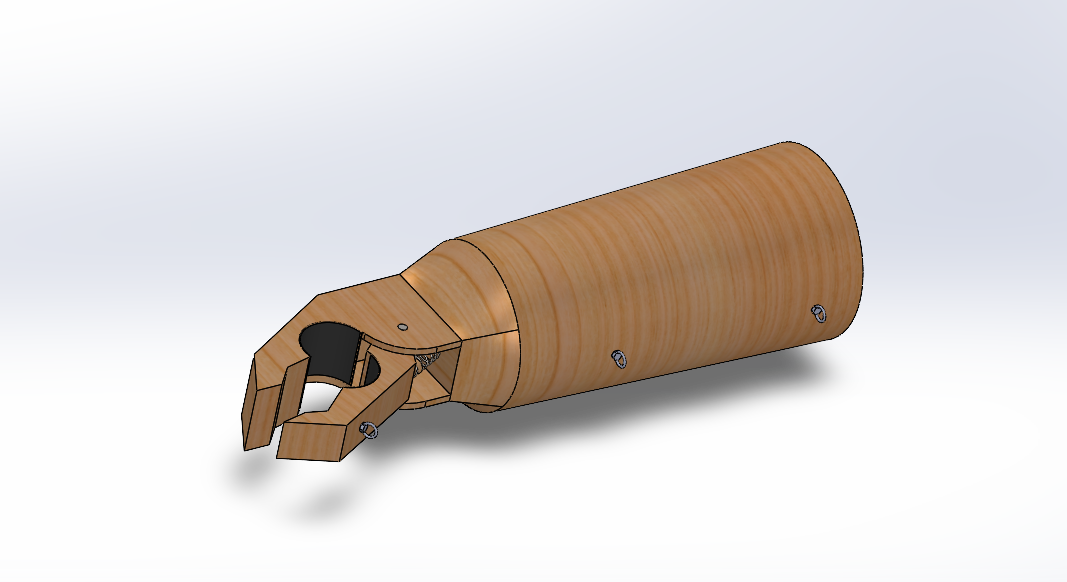
This was a three-person final project for BME 3891 at UCF. My focus was the mechanical design and validation: I modeled the full assembly in SolidWorks, ran the spring-force and grip calculations, and performed the finite element analysis used to validate the structure.
My Contribution
- Modeled the full prosthetic assembly from scratch in SolidWorks — arm shaft, static and moving claw, hinge, pin, and spring
- Performed spring-force and spring-constant calculations to size the return spring for the grip mechanism
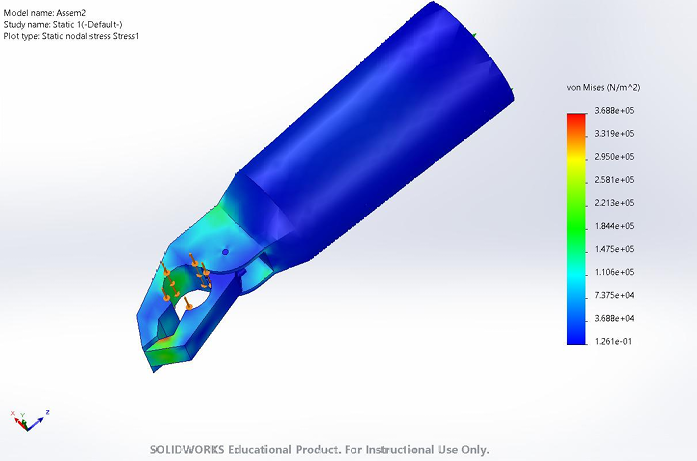
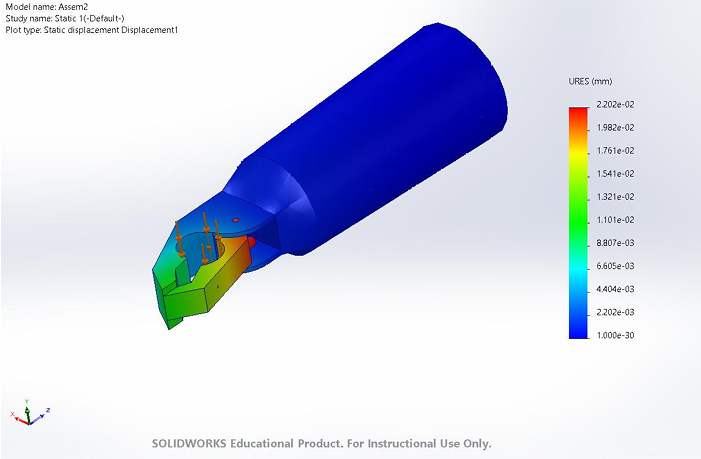
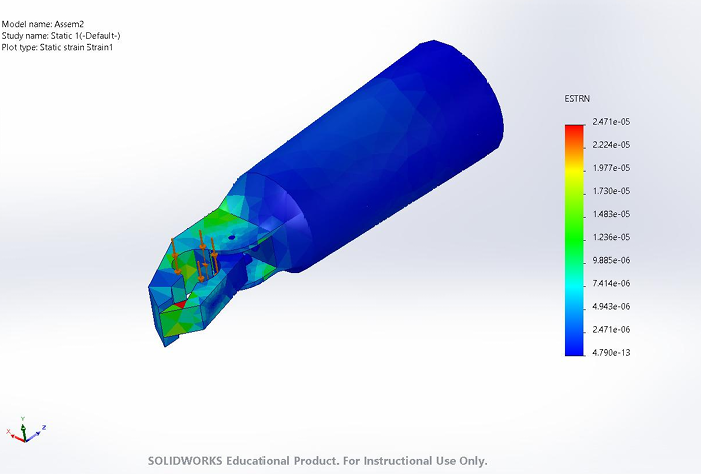
- Ran finite element analysis (Von Mises stress, displacement, and strain) to validate the structure under load
- Contributed to material selection and manufacturability decisions for a low-resource setting
Design Approach
The device was designed for a middle-aged, right-hand-dominant user with a trans-radial amputation of the left arm. Since the user retains their dominant hand, the prosthetic only needs to assist with holding, stabilizing, and carrying — not fully replicate hand motion. That reduced complexity and improved reliability.
A body-powered cable system was chosen over a myoelectric one: it uses shoulder motion to actuate the claw, needs no electronics or electricity, and can be maintained with basic tools. The terminal device is a voluntary-open claw — normally closed by a spring to hold tool handles securely, and opened by the user through the cable. A claw was selected over a mechanical hand for its stronger grip, better visibility of the grasped object, and fewer moving parts.
Materials
- Cedar wood — static and moving claw. Locally available in Afghanistan, easily machined from a solid piece with simple tools, and rubber-tipped at the contact points to improve grip and resist moisture
- Polypropylene — socket and main structural elements. Lightweight, durable, moisture-resistant, and reshapeable with heat — already standard in ICRC prosthetic manufacturing
- AISI 1020 steel — pin, eyelet bolts, and spring (cold-rolled, chosen for accessibility over ASTM A228 music wire)
Estimated total material and assembly cost: $40–$60.
Engineering Calculations
The claw is a normally-closed system, so the spring had to hold the claw clenched on a tool handle while still being openable by hand through the cable. The spring was sized around the force needed to grip a 10 lb shovel handle (1.5″ diameter, the common handle size the claw opening was designed around), yielding a required spring constant of approximately K ≈ 12.9 lb/in. The claw opening pairs with a rubber surface to grip the handle securely when fully closed.
Simulation & Validation
Each part and the final assembly were modeled and analyzed in SolidWorks as a static study. The model was fixed at the rear (as it would attach to the amputee's arm) with a 10 lb load applied at the claw's gripping surface to simulate holding a tool.
- Von Mises stress: Highest stress concentrated at the transition between the static claw and the main arm and at thinner features — the regions under greatest bending — while the rest of the arm and the pin stayed at low stress.
- Displacement: Largest deformation at the hinge and claw tips (farthest from support); the rest of the structure moved very little.
- Strain: Followed the same pattern as stress, confirming the claw-to-arm transition as the most critical region.
Overall, the analysis confirmed the design handles the applied load without excessive stress or deformation, with the highest-stress regions localized and improvable through minor geometry changes.